Contactless Payments Explained: How NFC Transactions Work
What is contactless payments in operational terms? It is a card-present payment method in which a chip card, phone, or wearable exchanges payment data with a compatible terminal without being inserted into a reader. The visible act is a tap.
Spencer Merrick·Updated: July 21, 2026·13 min read
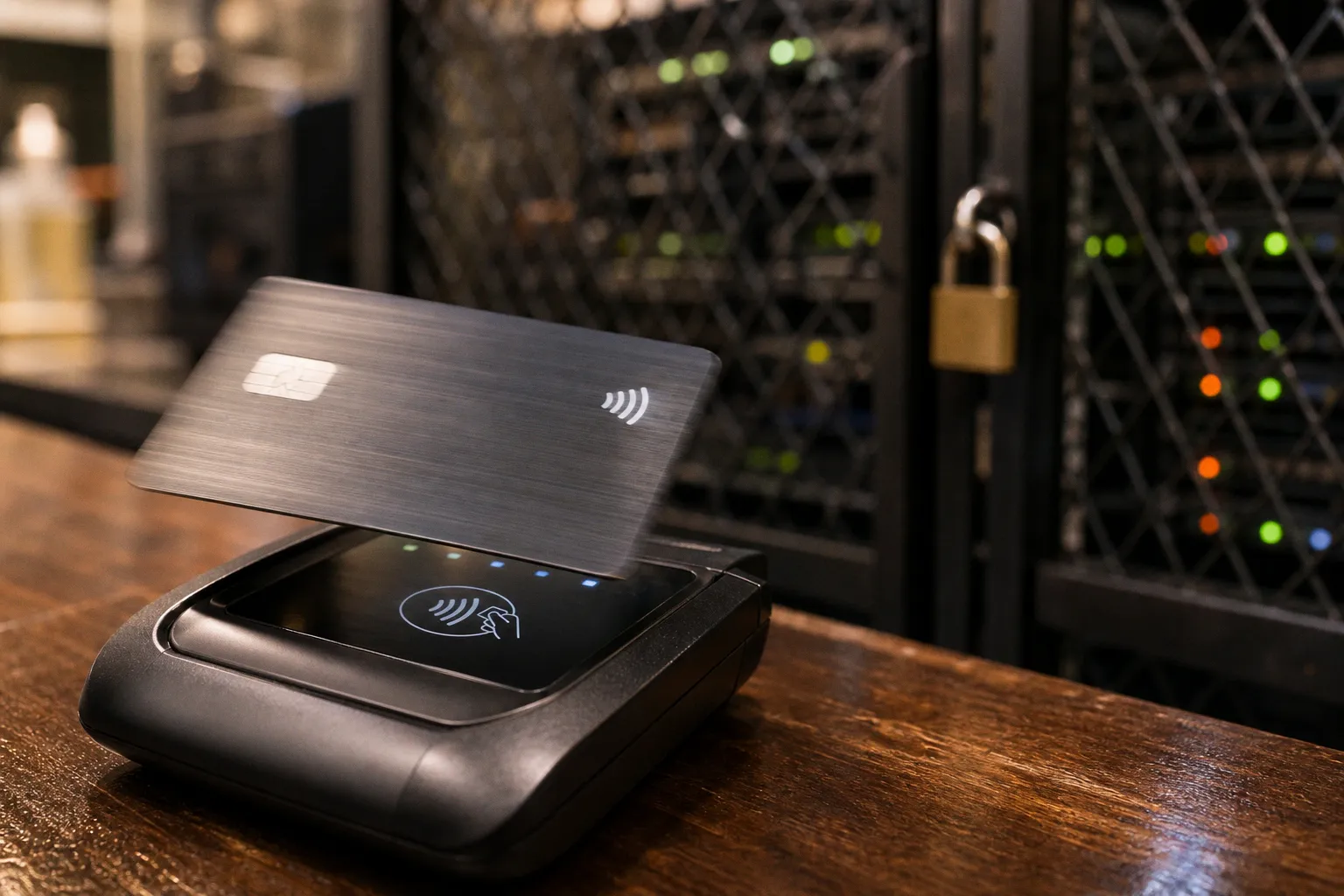
The actual system is an EMV transaction running across a very short NFC radio link, then through an acquirer, card network, and issuer authorization stack.
The tap is often presented as the security feature. It is not. NFC's short range reduces some exposure, but a payment is approved or declined because of EMV rules, terminal configuration, cryptographic data, cardholder-verification logic, network routing, and issuer risk controls. The radio interface is the smallest part of the system. It is also the part most likely to be misunderstood.
End-to-end processing time is not a fixed property of NFC. It depends on terminal configuration, acquirer capacity, payment-network routing, issuer response time, fraud-engine behaviour, and the quality of the merchant's connectivity. The radio exchange itself is short. Everything downstream of it can be much slower, and frequently is.
The physics of NFC: data moves at 13.56 MHz, not at "tap speed"
NFC payment technology operates at a base frequency of 13.56 MHz. Its typical operating range is up to around two centimetres, although the effective range in a real payment depends on antenna alignment, terminal power, device hardware, interference, and implementation quality.
That short distance matters. It makes accidental reads less likely and limits the practical space in which a reader and payment device can communicate. It does not mean that a contactless transaction is inherently immune to fraud, interception, terminal compromise, or unauthorized account use. Security is not created by proximity alone.
NFC supports data rates from 46 kbit/s to 1.7 Mbit/s. Those figures are useful only at the communications layer. They do not predict how long a customer waits at checkout. A transaction can be delayed by the terminal, merchant gateway, acquirer, card network, issuer host, fraud engine, or an unstable internet connection. A radio exchange may be brief while authorization remains slow.
There are two common consumer-side implementations:
| Payment instrument | NFC role | Where payment credentials are handled |
|---|---|---|
| Contactless chip card | The card communicates directly with the terminal | Payment application on the card chip |
| Phone or wearable wallet | The device emulates a contactless card | Wallet and secure credential environment, subject to the provider's architecture |
| Merchant phone accepting taps | The phone acts as the acceptance device | Merchant acceptance application, acquirer infrastructure, and applicable PCI controls |
A mobile wallet commonly uses NFC Card Emulation Mode. From the payment terminal's perspective, the phone or wearable behaves much like a contactless card. That compatibility is deliberate. The terminal is not being asked to understand every wallet's proprietary interface. It is executing an established contactless-payment framework.
This is why "tap to pay" is less a new payment rail than a new interface to existing rails. The transaction will generally still encounter the same parties that exist in a chip-card payment: merchant, acquirer, network, issuer, and a set of intermediaries responsible for routing, reconciliation, disputes, and compliance.
A contactless payment is not a payment made "through the air." It is an EMV payment whose first few centimetres happen to be wireless.
EMV contactless chip and the anatomy of a transaction
Contactless card mechanics are governed by EMV specifications and payment-network rules. EMV is not a consumer brand and not a single product. It is a technical and operational framework for chip-based payment processing. In the contactless flow, it defines how the payment device and the acceptance terminal identify each other, exchange data, select an application, apply transaction rules, and create transaction-specific security data.
A simplified transaction sequence looks like this:
1. The terminal detects the card or device.
The NFC field is active. A contactless card, phone, or wearable is brought close enough for communication. The device responds and establishes the data exchange.
2. A payment application is selected.
The terminal identifies a compatible payment application. This is where network and card-product logic begin to shape the transaction.
3. Terminal and device exchange transaction data.
The terminal supplies information such as the amount, currency, transaction type, and its own capabilities. The card or wallet supplies data required by the EMV application and payment network.
4. Risk and cardholder-verification rules are evaluated.
The terminal determines which verification methods it can support. The card, wallet, issuer configuration, network rules, transaction amount, market, and transaction context all affect the outcome.
5. A transaction-specific cryptographic value is generated.
EMV Contactless Chip uses a one-time-use security code for each transaction. This is a central distinction from legacy magnetic-stripe data, where static data could be copied and reused more easily.
6. The authorization request is routed.
The merchant's acquirer or payment service provider transmits the request through the appropriate payment network to the issuer. The issuer applies account-status, fraud, and authorization rules.
7. The terminal receives an approval or decline.
The result is shown to the customer. The financial settlement, ledger posting, interchange calculations, merchant funding, and reconciliation work may continue later. Approval is not settlement.
The last point is routinely omitted in consumer explanations. A successful tap does not mean money has already reached the merchant's bank account. It means the authorization state has been established according to the applicable rules. Merchant acquiring systems then reconcile transaction records, fees, reversals, adjustments, and settlement files across several ledgers.
That distinction becomes material when a payment is reversed, duplicated, delayed, or disputed. The terminal receipt is an operational event. It is not the final accounting record.
The terminal is not a passive reader
A payment terminal contains a contactless kernel: software implementing the relevant EMV contactless processing requirements. The terminal's kernel, application configuration, supported cardholder-verification methods, network routing profile, and acquirer parameters influence what happens after the tap.
This is one reason contactless payments can behave differently at two merchants even when the same card and the same amount are used. One terminal may prompt for verification. Another may not. One may support a given wallet interaction cleanly. Another may fall back, time out, or display an unhelpful generic decline.
The customer sees a uniform gesture. The merchant estate is not uniform.
Tokenization and cryptograms: beyond the primary account number
Tokenization is often described as if it were synonymous with mobile payments. That is inaccurate.
In a tokenized mobile-wallet transaction, the underlying primary account number, or PAN, can be replaced with a device-specific payment token. Some schemes refer to this as a Device Account Number. A transaction-specific cryptogram is then added to the payment message. The merchant and many intermediaries do not need to receive the underlying PAN in the same form used by the physical card.
This can reduce the value of exposed payment credentials in certain compromise scenarios. A token tied to one device and one wallet context is not automatically useful elsewhere. But the architecture must be described precisely.
- EMV contactless does not automatically mean tokenized. A contactless chip card can conduct an EMV transaction using its card credentials without a mobile-wallet token.
- A phone payment is not secured by tokenization alone. Device security, wallet provisioning controls, user authentication, issuer controls, cryptographic processing, and fraud monitoring remain relevant.
- A token is not a replacement for authorization. The issuer can still decline the transaction based on available funds, account restrictions, risk scoring, suspected fraud, or network conditions.
- A cryptogram is not merely encrypted card data. It is transaction-specific security data generated as part of the EMV process. Its purpose is to support validation that the transaction data has not simply been replayed from a prior purchase.
The conceptual distinction matters because payment systems are frequently marketed through vague equivalences: tokenization equals safety; biometrics equal approval; NFC equals security; a wallet equals a new rail. None is structurally correct.
A biometric check on a phone may satisfy a wallet's device-unlock or user-authentication policy. Whether and how that maps to the cardholder-verification method recognized in the transaction depends on the wallet, issuer, network rules, device behavior, and the specific payment context.
The same confusion appears in adjacent digital-rights markets. A purchaser can possess a digital product while the relevant underlying rights remain constrained by a separate chain of permissions. The logic is familiar to people who check sample clearances before buying digital rap albums: an interface can confirm a transaction, but it cannot erase the legal and operational dependencies underneath it. Payments work similarly. The tap is only evidence that one interface step occurred.
Tokenization reduces exposure to a static account identifier. It does not remove the issuer, the network, the acquirer, or the risk decision from the transaction.
The reality of cardholder verification and transaction limits
The popular formulation is simple: small purchases need no PIN. It is also unreliable.
Whether a contactless transaction requires cardholder verification depends on the market, network, issuer preferences, transaction amount, domestic or international context, terminal capabilities, and the payment device itself. Verification may involve a PIN, a device-based method such as biometric authentication, another supported method, or no cardholder verification method at all.
No global contactless payment limit can be quoted responsibly. Limits are not properties of NFC. They are market and rules-engine parameters.
A domestic threshold in one country may be raised, lowered, or replaced by a more conditional rule. Visa's published rules, for example, recorded an increase in Türkiye's domestic contactless limit from TRY 1,500 to TRY 2,500 effective April 18, 2026. That figure says nothing about the limit in another market, for another network, at another merchant type, or for a cross-border transaction.
The operational model is better understood as a set of conditional decisions:
| Question | What can determine the answer |
|---|---|
| Is contactless permitted? | Terminal configuration, card or wallet capability, network and local-market rules |
| Is cardholder verification required? | Amount, issuer settings, merchant location, transaction type, terminal capability |
| Is the payment tokenized? | Whether the payment is made through a tokenized wallet and how credentials were provisioned |
| Is online authorization required? | Terminal risk settings, network rules, issuer controls, transaction context |
| Will the payment be approved? | Funds, account status, issuer fraud controls, authentication results, routing and connectivity |
This conditional structure is not a flaw. It is the mechanism by which a global payment system accommodates local regulation, domestic schemes, issuer risk tolerances, and different merchant environments. The flaw is the attempt to hide that structure behind claims that contactless payments are universally "frictionless."
Friction has not disappeared. It has been redistributed. A PIN prompt, a biometric request, a declined tap, or a request to insert the physical card is the system exposing a decision that had previously been invisible.
Security of contactless payments is layered, not automatic
The security of contactless payments rests on multiple controls with different failure modes.
Short NFC range constrains the physical communication channel. It makes the interaction intentional in ordinary use, but it is not a complete security model.
EMV transaction processing produces transaction-specific data, including the one-time-use code used in each contactless transaction. This raises the difficulty of straightforward replay attacks compared with static-card-data systems.
Tokenization, where deployed, can reduce circulation of the underlying PAN in mobile-wallet transactions. It is particularly relevant when a device-specific token is used instead of the physical card number.
Cardholder verification can add a second control, but its application is not universal. It is selected according to transaction and rule-set conditions.
Issuer authorization and fraud controls remain decisive. An issuer can decline a technically valid EMV transaction because the account is blocked, the behavior is anomalous, the balance is insufficient, or the authorization pathway fails.
Merchant and acquirer controls determine whether the acceptance environment is configured, certified, monitored, and reconciled correctly. A strong card protocol cannot compensate for a badly managed merchant integration or exposed payment environment.
The weak point is often not the contactless exchange itself. It may be an account takeover that occurred before the tap, malware on a merchant endpoint, weak access controls around a payment gateway, a misconfigured API integration, or delayed reconciliation between the acquirer's transaction records and the merchant's internal ledger.
A payment system should therefore be assessed as a chain. Focusing only on whether a phone needs to be held within two centimetres of a terminal is a category error.
From dedicated terminals to Tap to Phone and MPoC
Contactless acceptance is moving beyond purpose-built payment terminals. A commercial off-the-shelf phone or tablet with native NFC can be used to accept payments. This model is often described as Tap to Phone or SoftPOS.
The commercial appeal is obvious. A small merchant can accept card-present payments without purchasing and maintaining a dedicated pin pad. A delivery business can turn a staff phone into a point of sale. A large acquirer can extend acceptance to locations where terminal deployment would have been uneconomic.
The compliance burden does not disappear with the hardware.
A consumer phone accepting payments is part of the merchant acceptance environment. It must be supported by an acquirer and payment-network framework, protected through the relevant security controls, and operated under applicable PCI standards. Native NFC is necessary for the interaction. It is not sufficient for compliant acceptance.
The standards landscape is also changing. The PCI Security Standards Council has set a formal sunset period for its Contactless Payments on COTS, or CPoC, standard from May 1 through October 31, 2026. Entities operating under that model are being directed toward the newer Mobile Payments on COTS, or MPoC, standard.
This is not just a terminology update. MPoC reflects a broader acceptance architecture in which payment capture, PIN handling where applicable, software security, remote management, and device integrity must be considered together. The old distinction between "terminal" and "merchant application" becomes less stable when the acceptance device is a general-purpose smartphone.
That shift increases deployment speed. It also expands the attack surface. Dedicated terminals were never free of operational risk, but they were built for a narrow purpose. Consumer-grade devices are used for messaging, browsers, application downloads, identity functions, and payment acceptance. Segregation of payment code from the rest of the device becomes harder to enforce by design.
PCI MPoC acknowledges this by combining device attestation, software protection, merchant-side monitoring, and ongoing integrity checks into a single evaluation framework, rather than treating the smartphone as a sealed payment terminal. The result is a more realistic set of controls for the hardware people actually carry, and a more demanding compliance workload for the acquirers that onboard those merchants.
The broader lesson is the same one that runs through the entire system. The visible interface, the tap, is a small, well-understood piece of a much larger mechanism. NFC defines a radio exchange. EMV defines what happens next. The acquirer, network, and issuer decide whether the transaction exists in any meaningful sense. Tokenization, verification, and authentication shape how much weight that decision carries. Standards like MPoC determine who is allowed to put an acceptance device on a counter.
If you treat contactless payments as a tap, you will misunderstand them. If you treat them as an EMV transaction with a wireless front end, the operational behaviour of the system - the limits, the declines, the prompts, the risk decisions, the security layers, and the compliance burden of newer acceptance devices - starts to make sense.