What Is the Contactless Payments Limit?
The contactless payments limit is no longer a simple national number printed on a card-network leaflet. In the UK, the regulatory ceiling of £100 disappeared on 19 March 2026.
Dexter Bowers·Updated: July 17, 2026·12 min read
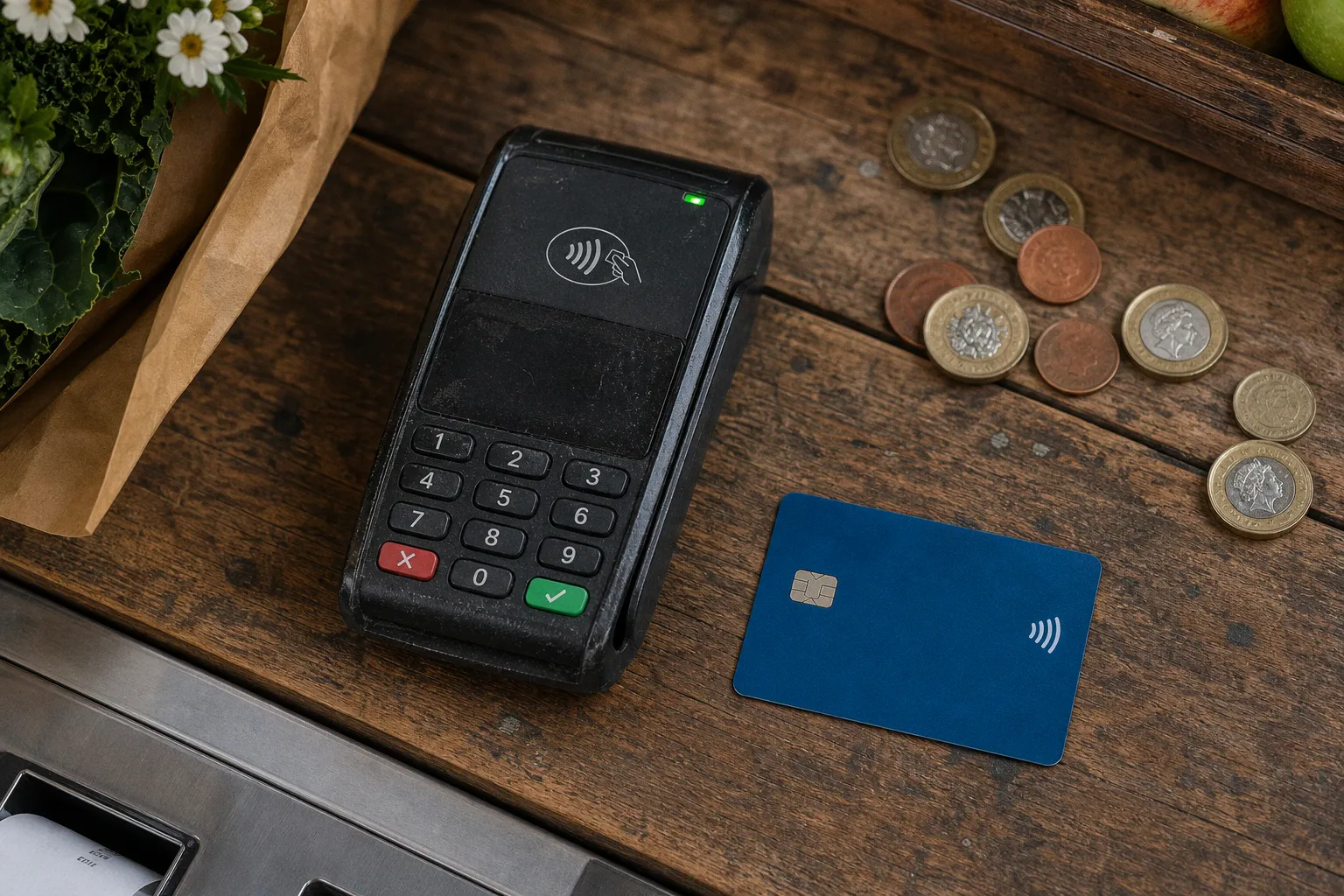
Yet the practical limit for most cardholders remains £100, because the banks that carry the fraud loss, customer-support cost and authentication burden have not rushed to move it.
That gap is the point. A contactless transaction limit is not primarily a UX feature. It is a risk-allocation mechanism: a threshold at which the issuer decides that a tap is cheap enough to approve without asking the customer for a PIN, while the expected fraud cost remains tolerable. Raise the threshold and payment friction falls. Raise it too quickly and fraud losses, disputes and operational costs start consuming the interchange margin that made the transaction attractive in the first place.
For consumers, the question sounds basic: how much can I tap to pay? For issuers, acquirers and wallet operators, it is more consequential: how much authentication can the payment stack safely remove before the economics deteriorate?
The shift from national caps to bank-led limits
A contactless card limit is the maximum value that can usually be paid with a physical card tap before additional verification, typically a PIN, is required. Historically, regulators and domestic payment systems often set a common ceiling. That model offered clarity, but it also imposed a one-size-fits-all risk threshold on institutions with very different fraud models and customer bases.
The UK’s decision to remove the national £100 cap changes the governance model rather than instantly changing customer behavior. The Financial Conduct Authority has given banks with adequate fraud controls room to set their own limits. It has not instructed them to raise those limits, and most major high-street banks have kept the £100 threshold for now.
That is a rational pause, not institutional inertia.
A higher tap to pay limit does not simply require a bank to alter a number in its authorization rules. The issuer has to assess fraud patterns by portfolio, card type, merchant category, geography and customer segment. The acquirer and merchant must ensure terminals can process the revised authentication logic. Customer-service teams need a coherent answer when a transaction is declined because the card, terminal or network applied a different rule than the customer expected.
If the issuer earns only a narrow margin on a retail card purchase, then a modest increase in fraud incidence can erase the revenue benefit of a smoother checkout. The commercial case is strongest where higher-value contactless payments replace cash, manual card entry or slower chip-and-PIN flows. It is weakest where the same consumer would have used a biometric wallet anyway.
Removing a regulatory ceiling does not create payment capacity. It transfers the decision — and the downside — to the institution holding the fraud exposure.
The UK is therefore becoming a useful case study in bank-led payment policy. Regulators have removed a constraint; banks are now pricing the risk in real time. If fraud controls improve and terminal software catches up, individual issuers may move above £100. If losses remain elevated, the market may discover that the old cap was less a regulatory burden than a convenient equilibrium.
Contactless limits vary because payment economics vary
There is no universal NFC payment limit. Limits differ by country, payment rail, card issuer, card type and whether the customer uses a physical card or a tokenized digital wallet.
The variation is substantial:
| Market | Typical PIN-free physical-card threshold | What is changing |
|---|---|---|
| United Kingdom | £100 at most major banks | National cap removed in March 2026; issuers can set their own limits, but most have retained £100 |
| Eurozone | €50 | The common practical threshold in markets including France, Germany and Spain |
| Canada | Up to CAD 500 for Interac debit | Interac increased the maximum from CAD 250 in September 2025, with rollout varying by institution |
| United States | Typically USD 100–250 | No federal cap; issuer and network rules determine the limit |
| Turkey | 2,500 TL | PIN-free limit increased from 1,500 TL on 15 January 2026 |
| Australia | Typically AUD 200 | A relatively high threshold, reflecting the market’s mature contactless usage |
These are not directly comparable merely by exchange rate. The relevant measure is how the threshold maps onto everyday basket size, fraud rates, authentication habits and merchant infrastructure.
Canada’s move toward a CAD 500 maximum for Interac debit is notable because it treats contactless not merely as a low-ticket convenience rail, but as a viable method for a much larger share of routine retail spending. That does not mean every bank immediately enables CAD 500 taps, nor that every merchant terminal is ready to handle them. It means the domestic debit system has created room for institutions to compete on friction.
Turkey’s increase to 2,500 TL follows a similar logic: inflation changes the practical meaning of a fixed nominal payment limit. A threshold that once covered ordinary groceries may eventually fail to cover a standard basket. Keeping it unchanged can push consumers back toward PIN entry or wallets, which may be fine from a security perspective but weakens the core convenience promise of contactless cards.
The Eurozone’s typical €50 threshold remains more conservative. That is not necessarily a sign of technological lag. It reflects a different balance between strong customer authentication requirements, consumer expectations and domestic payment habits. A lower contactless transaction limit can coexist with high digital-payment adoption when wallets and local account-to-account methods handle the higher-value use cases.
The US is more fragmented. There is no federal contactless limit, and issuer practices commonly fall in the USD 100 to USD 250 range. That is what happens when a market has multiple card networks, issuers, processors and merchant-acquiring arrangements: the rule becomes portfolio-specific rather than nationally legible. Consumers see inconsistency; issuers see flexibility.
A per-transaction limit is only half the control system
The number shown in a bank’s contactless policy is not the full rule. Most issuers use cumulative limits, transaction counters and risk-based prompts to prevent a stolen card from being tapped repeatedly before the loss is detected.
In the UK, Strong Customer Authentication is generally required after either five consecutive contactless transactions or cumulative contactless spending of £300. In practice, that means a customer can remain below the £100 single-purchase ceiling and still be asked for a PIN. The system is not malfunctioning. It is deliberately forcing a periodic reset of the authentication chain.
Some US issuers use comparable cumulative thresholds, often requiring a PIN after daily contactless spending reaches roughly USD 300 to USD 500. The exact policy depends on the issuer, the card program and the transaction environment.
This matters because an increase in the headline tap limit does not automatically multiply fraud exposure by the same amount. A bank can raise the maximum value of a single contactless transaction while keeping a tight cumulative threshold, or it can use transaction-scoring models to step up authentication when behavior deviates from the customer’s usual pattern.
A workable control stack usually combines several layers:
1. A single-transaction ceiling. This limits the exposure from one unauthorized tap and sets the most visible contactless card limit for the consumer.
2. Cumulative spend and transaction-count rules. These force periodic cardholder verification even where each individual purchase remains below the nominal cap.
3. Velocity monitoring. Multiple taps in a short period, especially at unrelated merchants or in unusual locations, can trigger a decline or an authentication request.
4. Merchant and device signals. The payment system can differentiate between a physical-card tap, a wallet token, a familiar merchant and an unusual terminal environment.
5. Post-authorization fraud controls. Issuers can block the card, notify the customer or reverse exposure quickly when a pattern becomes suspicious.
This is why arguments about “raising the limit” are often too crude. The relevant question is not whether an issuer permits a £150 or £200 tap. It is whether that issuer can do so while maintaining acceptable fraud losses, authorization rates and service costs.
If the answer is yes, a higher limit can improve checkout conversion and reduce customer friction. If the answer is no, the bank is effectively buying headline convenience with future chargebacks and call-centre volume. That is not innovation. It is margin compression with better branding.
Digital wallets change the authentication equation
Digital wallets complicate the discussion because Apple Pay and Google Pay usually authenticate the user with biometrics or device credentials before the payment token reaches the terminal. Face ID, fingerprint verification or a device passcode gives the issuer a stronger signal than an unattended physical-card tap.
As a result, wallets generally do not impose their own low-value contactless ceiling in the way a physical card does. A customer may be able to pay for a higher-value purchase with a phone or smartwatch even when the physical card would have required a PIN.
But “generally” is doing real work here.
The wallet transaction remains subject to the linked card issuer’s controls, network rules and the merchant terminal’s capabilities. A bank can decline the authorization. A terminal can fail to support the relevant contactless flow. A merchant may set operational restrictions. And a wallet’s biometric authentication does not mean every transaction is unlimited under every circumstance.
The strategic distinction is straightforward:
| Payment method | Authentication signal | Typical implication for higher-value payments |
|---|---|---|
| Physical contactless card | Possession of the card, plus periodic PIN reset | Subject to a visible per-transaction and cumulative limit |
| Mobile wallet | Biometric or device credential plus tokenization | Often supports higher-value payments with less apparent friction |
| Chip and PIN | Card possession plus PIN entry | Reliable fallback when contactless controls are triggered |
| Manual card entry | Card details, often with additional online controls | Higher friction and generally weaker in-store customer experience |
For banks, wallet adoption can be economically useful. Tokenization reduces the exposure of raw card credentials, biometric authentication lowers certain fraud vectors, and a successful wallet transaction may preserve a payment that would otherwise fail at checkout.
There is a trade-off. Wallets also shift customer engagement toward Apple, Google and device ecosystems rather than the bank’s own interface. For an issuer with weak card economics, that can still be acceptable: keeping the transaction and preserving interchange revenue is better than losing payment volume to cash, alternative financing or a competing wallet.
For neobanks, the calculation is sharper. Their customer acquisition cost is often front-loaded, and card spending is one of the few recurring behavioral signals available to justify that acquisition expense. If physical-card limits create avoidable payment failures, the customer may migrate spending to another card. If wallets solve the problem, the neobank keeps transaction relevance — but not necessarily the front-end relationship.
The wallet does not abolish the contactless limit; it replaces a blunt possession test with a stronger authentication signal.
Why higher limits still fail at the terminal
Payment regulation can change overnight. Merchant acceptance does not.
The UK’s post-£100 environment illustrates the point. Even if an issuer decides to set a higher physical-card limit, the transaction still passes through a merchant terminal, an acquirer, a processor and network configurations that may not yet recognize or support the updated policy. Terminal software updates take time, particularly across fragmented small-business estates.
This is a familiar payments problem: the slowest party in the chain sets the practical product limit.
Merchants also have their own incentives. Large retailers with modern estate-management systems can deploy software changes relatively quickly. Independent merchants may rely on terminals supplied by acquirers, payment facilitators or point-of-sale vendors that update in batches. Their concern is not the elegance of a new national framework; it is whether a change will increase declines, create reconciliation issues or produce longer queues at peak trading hours.
Acquirers face a related problem. They earn on transaction volume and merchant retention, but they also absorb the cost of terminal support, certification cycles and operational disruption. If a higher contactless threshold produces only marginal volume uplift while increasing helpdesk traffic, the urgency is limited.
The result is a staggered market:
- A bank may permit a higher contactless transaction.
- A customer may hold a card eligible for that higher threshold.
- A particular terminal may still request a PIN or decline the tap.
- The same card may work differently at another merchant five minutes later.
That inconsistency is frustrating for consumers, but it is predictable in an ecosystem built from legacy terminals, issuer-specific risk controls and different upgrade schedules.
The cleanest way to view the rollout is not as a binary switch from “£100” to “no limit.” It is a migration from a national rule to a network of institutional policies. The visible customer experience will remain uneven until issuers, acquirers and merchants converge on new operating assumptions.
The real limit is the issuer’s fraud-adjusted margin
So, what is the contactless payments limit? On the surface, it is the maximum amount a customer can pay with a tap before being asked for a PIN or another form of verification. In reality, it is a moving boundary between friction and fraud.
The UK has removed its national cap, but the market has not yet repriced the risk. Most major banks retaining £100 tells us more than the FCA’s rule change does: issuers see insufficient economic upside, or insufficient operational readiness, to move first.
Canada’s higher Interac ceiling, Turkey’s inflation-driven increase, the eurozone’s €50 norm and the issuer-led US model all point to the same conclusion. There is no globally optimal tap to pay limit. There are only local compromises between basket size, authentication quality, merchant technology and fraud tolerance.
Banks that can use wallets, cumulative controls and real-time risk scoring to maintain low losses will raise limits selectively. Banks that cannot will keep the old thresholds and call it prudence. In payments, that distinction eventually separates scalable transaction economics from a convenience feature that costs more than it earns.