KYC verification means: what it is and how it works
We need to talk about the awkward selfie. The one taken at 11 p.m., forehead pressed too close to the phone camera, while a checklist politely demands you tilt your passport "5 to 15 degrees clockwise" so the OCR can make sense of it.
Jocelyn Davenport·Updated: July 06, 2026·13 min read
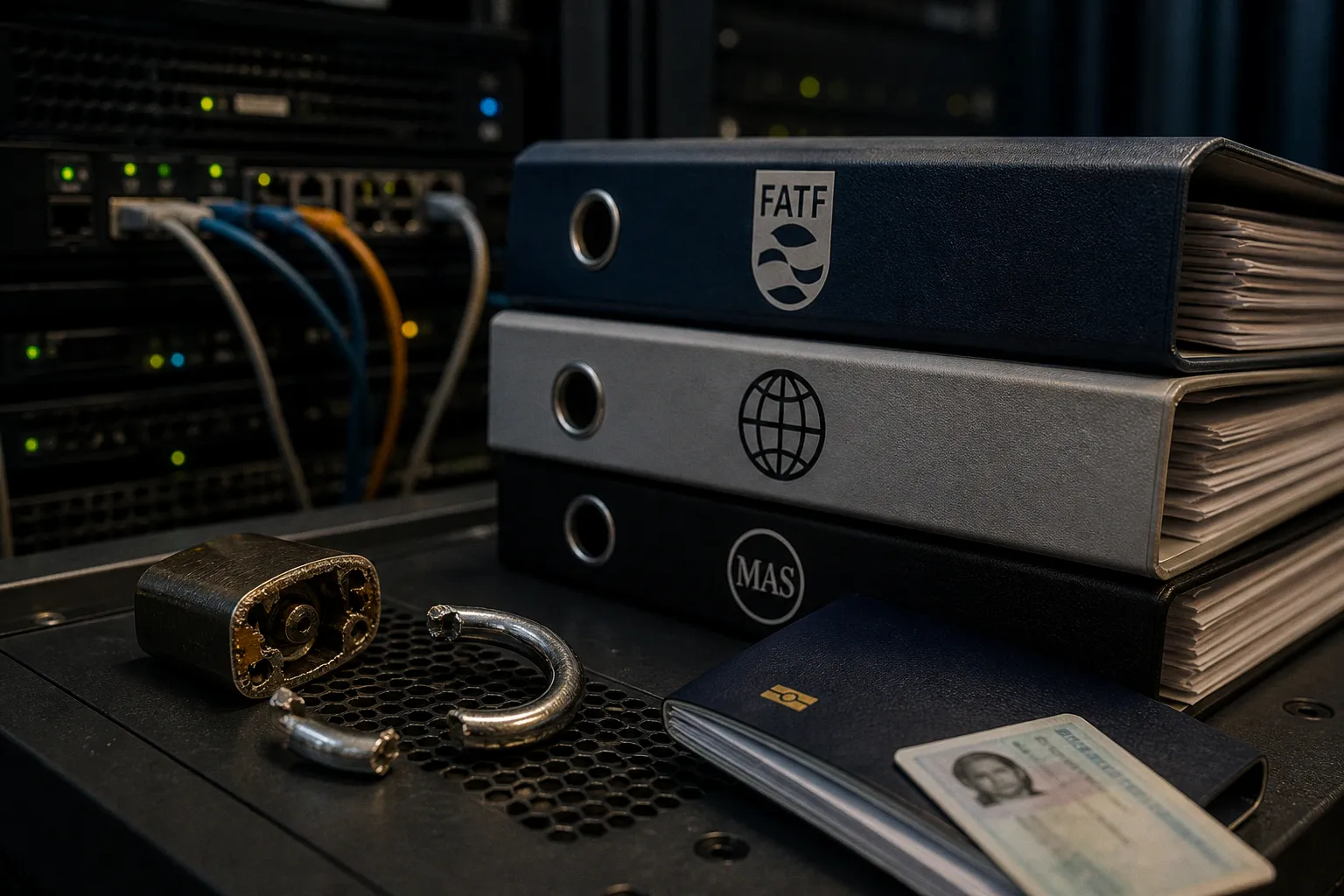
KYC stands for "Know Your Customer," and at its core it is a mandate that requires financial institutions — from your neighborhood credit union to a cross-border neobank you downloaded last week — to verify who their customers are, assess what kind of risk those customers might bring, and keep watching that picture over time. The mandate has been shaping global finance for decades, but the technology behind it has changed dramatically. The webcam, the chip inside your passport, the algorithm comparing your selfie to the photo on your ID — none of that existed in the form we now interact with even fifteen years ago. What hasn't changed is the underlying obligation: a bank has to know who it is doing business with, or it doesn't get to be a bank.
The Regulatory Backbone: Where KYC Actually Comes From
To understand what KYC verification means in practice, you have to start with the rulebook rather than the app screen. The global template for these obligations comes from the Financial Action Task Force (FATF), an intergovernmental body whose recommendations most jurisdictions either adopt directly or transpose into national law. The FATF's basic requirement is straightforward: financial institutions must verify the identity of every customer before establishing a business relationship, must understand the purpose of that relationship, must assess the risk it carries, and must keep records and monitor activity throughout the life of the account.
In the United States, that mandate is enforced by FinCEN — the Financial Crimes Enforcement Network — which in 2016 finalized its rule on Customer Due Diligence, formally folding what had previously been scattered guidance into a binding obligation for banks, broker-dealers, money services businesses, and certain other covered entities. That 2016 rule effectively set the floor for what American users now experience as a "KYC check process": a customer identification step, a risk-tiering step, an identity verification step, and an ongoing monitoring step. Other jurisdictions run their own variants — the EU's anti-money laundering directives, the UK's Money Laundering Regulations, Singapore's MAS Notice 626, Brazil's BCB circulars — but they all trace back to the same international recommendations.
The point worth holding onto here: KYC is not a product feature. It is a legal floor. When a fintech brags about its "frictionless onboarding," what it usually means is that it has figured out how to satisfy a legal floor in fewer taps, not that it has found a clever loophole.
Friction at signup isn't bad design. It's compliance architecture made accidentally visible.
The Three Layers: CIP, CDD, EDD, and Ongoing Monitoring
Inside that legal floor sit four distinct layers, and they explain why you sometimes get asked the same thing twice — and why a perfectly routine transaction can suddenly trigger a review months after you opened the account.
The first layer is the Customer Identification Program (CIP). This is the bare-bones identity check: who are you, and can you prove it? In a digital onboarding flow, that's the combination of a government-issued ID upload, a selfie, an address, and a date of birth — all of which get checked against the issuing authority's records or a trusted third-party data source. CIP is supposed to run before any account is opened.
The second layer is Customer Due Diligence (CDD) — the risk assessment that sits on top of identification. A CDD step asks not just "who are you" but "what are you likely to do with this account?" It uses factors like your occupation, the country you are in, the products you are applying for, and the expected size and frequency of your transactions to assign you a risk tier. Low-risk customers get the standard treatment. Higher-risk customers get pulled into the third layer.
The third layer is Enhanced Due Diligence (EDD), which kicks in for customers the system considers high-risk — typically Politically Exposed Persons (PEPs), individuals from jurisdictions with elevated money-laundering exposure, or anyone whose activity triggers the institution's own internal thresholds. EDD requires deeper verification, more documentation, and usually senior-level sign-off inside the institution. From your side, that can look like a long delay, a request for source-of-funds paperwork, or a sudden onboarding freeze.
And then there is ongoing monitoring, which never stops. KYC is not a one-time gate you walk through and forget. Once your account exists, the institution is required to keep screening it against updated sanctions lists, adverse media, and behavioral baselines. That is why your routine withdrawal can suddenly flag for review months after you opened the account: the world has shifted around your profile, even if your life hasn't.
| Layer | What it asks | When it runs | What it feels like |
|---|---|---|---|
| CIP | Who are you, and can you prove it? | At account opening | The selfie-and-passport step |
| CDD | What risk do you bring? | At opening, periodically | The "tell us about your job" form |
| EDD | Are you high-risk enough to deserve deeper checks? | When PEPs, sanctions, or unusual patterns appear | Source-of-funds requests, longer reviews |
| Ongoing Monitoring | Has anything about you or your activity changed? | Continuously, in the background | Sudden account holds, re-verification prompts |
How Automated Identity Verification Actually Works
The selfie-and-passport moment feels arbitrary, but each step in it is calibrated to satisfy a specific CDD requirement with as little cognitive load on you as possible — or at least, that is the design goal. Most modern KYC workflows now run on a stack of three integrated technologies, and understanding them demystifies the choreography considerably.
Optical Character Recognition (OCR) does the first reading. It scans the machine-readable zone and the visual inspection zone of your passport or driver's license and extracts the printed fields — name, date of birth, document number, expiration date, issuing country — into a structured record. Older KYC flows had a human operator re-typing this. OCR is what replaced them, and it is also what allows the same data to flow instantly into the institution's case management system without a human in the loop.
Near Field Communication (NFC) does the second, more rigorous check on supported documents. If your ID has a chip — most modern passports and many national ID cards do — the app can prompt you to tap it, and the chip returns cryptographically signed data that confirms the document is genuine and unaltered. That chip data is far harder to forge than a printed page, which is why NFC-based verification is fast becoming the default for European and many Asian onboarding flows. It also exposes the kind of subtle forgeries — altered dates, swapped photos, simulated chips — that visual OCR alone would miss.
Biometric facial matching closes the loop. The selfie you take is compared against the photo extracted from the ID document — either the printed portrait or, in NFC flows, the chip-stored image. A liveness check layered on top verifies that you are physically present, not just presenting a static photo or a deepfake. The matching itself is run by a machine-learning model trained to look past makeup, aging, glasses, and lighting, while still catching masks, deepfakes, and printed photo attacks. None of this is a guarantee against fraud — the honest framing here matters: no KYC automation eliminates fraud, it just changes the cost economics of attempting it — but stacked together, OCR + NFC + liveness + biometric face-match raise the bar high enough that mass-scale synthetic identity fraud becomes uneconomic for most attackers.
The selfie isn't the security. The selfie is the one part of the chain that requires you to be physically present.
The reason these three pieces are now so often fused into a single five-second interaction is choice architecture. Every additional tap or question is an opportunity for you to abandon the onboarding flow, and abandoned flows cost the institution its customer acquisition. Behavioral economics meets regulatory compliance, and the awkward selfie is the seam between them — the place where a thousand-year-old anti-money-laundering tradition meets a 2024 conversion funnel.
When the System Stares Harder: Enhanced Due Diligence
For most everyday users, the KYC flow ends at CDD and never returns. But for some categories of customers, the system stares longer. Enhanced Due Diligence is where the regulatory floor gets thicker, and it is also where a lot of the consumer complaints about KYC actually originate.
The trigger for EDD is usually one of three things. The first is your profile: if you are classified as a Politically Exposed Person — meaning you hold, or recently held, a prominent public function — most jurisdictions require that institutions treat your onboarding as inherently higher-risk and apply additional scrutiny. The second is geography: if you are opening an account from, transacting to, or holding citizenship in a jurisdiction that FATF has placed on its heightened monitoring list, the institution is expected to apply additional checks regardless of who you individually are. The third is behavioral: if your transaction patterns deviate meaningfully from the baseline established during CDD, EDD-equivalent review can be triggered retroactively, sometimes years after you opened the account.
In all three cases, what EDD looks like from the user's side is more documentary burden and slower decisions. You may be asked for source-of-funds evidence — pay stubs, sale contracts, inheritance paperwork — for unusually large deposits. You may be asked to explain a complex beneficial ownership structure if you are opening a business account. And you will almost always wait longer. That wait is itself a feature of EDD, not a bug: a senior compliance officer generally has to sign off, and that officer is reading carefully.
A critical nuance worth flagging: EDD is not the same thing as denial. Many EDD reviews conclude that the customer is welcome, that the funds are clean, and that the relationship can proceed. The friction is the cost of certainty, not a prelude to rejection. From inside the institution, the same workflow that frustrates you is what lets the institution prove to a regulator — and, increasingly, to a court — that it exercised genuine diligence.
APIs, Watchlists, and the Real-Time Data Layer
The part of KYC that most users never see is also the part that has changed the most over the last decade: the real-time data layer behind the verification.
Modern identity verification APIs — services like Persona, Onfido, Jumio, Veriff, Trulioo, Sumsub, and a long list of regional specialists — pull together document verification, biometric matching, and watchlist screening into a single API call that a fintech can integrate in days rather than build in quarters. Behind those APIs sits a continuously updated mesh of data sources: global sanctions lists (OFAC, the EU Consolidated List, the UN Security Council list, HMT), Politically Exposed Persons databases, adverse media feeds, and law enforcement watchlists.
The interesting wrinkle is timing. Sanctions lists update constantly — sometimes within hours of a geopolitical event — and the institution's compliance obligation runs against the current state of the list, not the state of the list when you opened your account. That is why a transaction that was perfectly fine last Tuesday can be flagged this Wednesday: something about the counterparty, the geography, or you crossed an external threshold overnight. It is also why onboarding flows sometimes ask you to re-verify months after sign-up, especially when jurisdictional rules have shifted.
The architecture here matters because it explains why different fintechs feel different even when they all claim to "do KYC." The underlying APIs and the data quality they license vary considerably, and the rule logic on top of those APIs — the institutional risk appetite, the thresholds that trigger review, the speed of human escalation — is where the user-visible experience actually gets shaped. Two apps running the same vendor can produce noticeably different onboarding experiences.
Identity verification in banking is no longer one company's problem. It is a shared dependency on a shared data mesh.
What KYC Costs You, and What It Buys You
It is easy to read everything above and conclude that KYC is, on balance, a tax on users in service of banks and regulators. There is some truth in that. KYC friction is real friction, it shows up at the worst moments, and institutions have a clear incentive to keep the cost of compliance as low as possible — which sometimes means as invisible as possible, which sometimes means as opaque as possible. We have all had the experience of being suddenly locked out of our own account, told to "upload a clearer photo" of a document we uploaded successfully six months ago, with no human-readable explanation of why.
But the system also does work you wouldn't want to lose. The presence of KYC obligations is one of the reasons your grandmother's savings account at a regional bank is not, in practice, an attractive target for someone opening it under a forged identity and routing the proceeds out of the country. It is part of the reason a stolen credit card has a meaningfully harder time getting through a modern neobank's onboarding than it did in 2010. And it is part of the reason you, as a legitimate customer, generally don't end up underwriting someone else's laundering operation through the deposit insurance system without ever knowing it.
The broader regulatory environment extends well past the onboarding screen. Macroprudential rules, monetary policy, deposit insurance design — all of it shapes who is allowed to be a customer of whom, under what terms, on what timeline. KYC sits at the front door of that architecture: it decides who even gets to evaluate the products those other layers eventually make available, and under what conditions. Both halves of the system are doing the same kind of work from different ends of the pipeline, and treating them as separate problems misses the point.
Where KYC genuinely underdelivers is in the cost it imposes on people without conventional documentation, on cross-border users whose names trip every false-positive heuristic, and on anyone whose legitimate activity happens to look statistically unusual. The system often cannot tell the difference between "unusual" and "suspicious," and the cost of that ambiguity falls disproportionately on the user. That is a real problem worth naming, and it is one regulators are slowly beginning to grapple with through portable digital identity frameworks, mutual recognition schemes, and reforms aimed at harmonizing data-quality standards across vendors.
The version of KYC that future users will inherit will probably look less like an awkward selfie at 11 p.m. and more like a portable identity wallet: a verified credential you carry with you, present at the moment of account opening, and let institutions re-check selectively against shared infrastructure rather than rebuild from scratch every time you switch banks. The selfie, in that world, becomes a one-time act rather than a recurring ritual — a backstop for edge cases rather than the default. The legal floor doesn't go away. What changes is the plumbing under it. And if the regulators, the vendors, and the institutions can all agree on the shape of that plumbing, the next decade of onboarding may finally feel less like a checkpoint and more like a handshake.