Electronic KYC verification: efficiency vs security risks
Last summer, I tried to open a checking account with a mid-sized European neobank. The whole thing took 47 seconds.
Jocelyn Davenport·Updated: July 20, 2026·9 min read
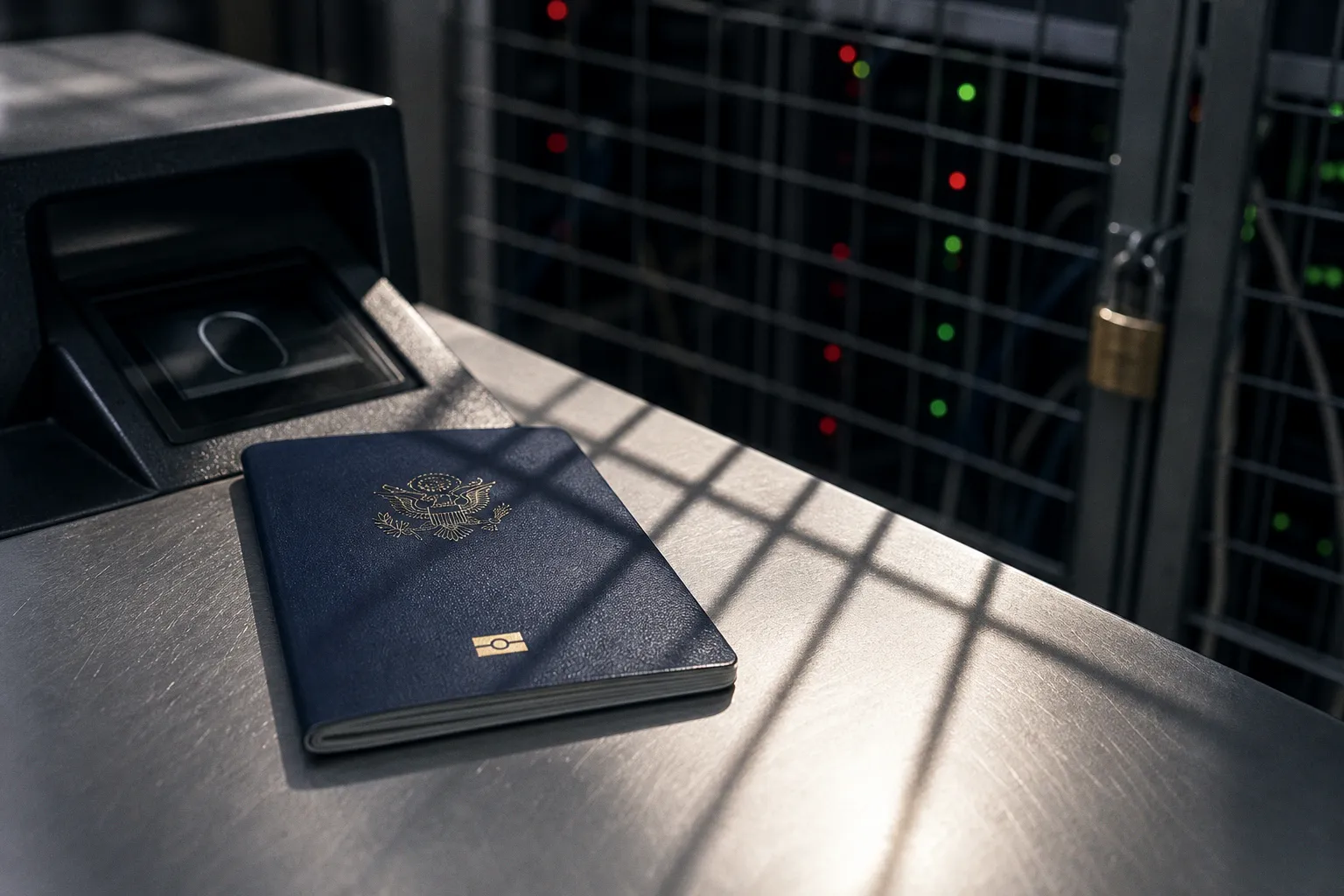
I know because I counted — mildly impressed — as the camera scanned my passport, a liveness check confirmed I wasn't a printed photograph, and a cheerful screen pronounced me "verified." Two weeks later, the same bank was in the news cycle because a competitor had been fined for letting synthetic identities slip through onboarding. People, that is, who technically do not exist. The 47-second onboarding had felt like a small miracle of UX design. In hindsight, it was also the exact window of time in which an AI-generated face could have walked through the front door, smiling.
That, in essence, is the paradox of electronic KYC verification. We built it to dissolve friction, and dissolve friction it did. Average AI-powered identity checks now run between 12 and 30 seconds. Banks that once spent $1,500 to $3,000 per manual review have automated between 48% and 70% of those costs out of existence. And yet 87% of financial institutions reported encountering AI-generated synthetic identity attacks in 2025. The same rails that shrank onboarding from days to half a minute have become the easiest place to slide a fake person into the financial system. Speed and risk, it turns out, scale together.
The economic imperative of sub-30-second onboarding
To understand why the industry chose speed first, you have to understand what came before. A traditional KYC review — the kind where a human analyst physically inspects a utility bill, cross-references a passport, and waits on a callback from a compliance officer — can take anywhere from several hours to 14 days. For a bank, that's a cost line item of $1,500 to $3,000 per file. For a customer, it's a week of refreshing an inbox.
In the behavioral economy of digital banking, that week is fatal. Seventy percent of financial firms reported losing potential clients in 2024 due to friction in the KYC process — up from 48% the year before. Every additional screen, every "we'll get back to you within five business days," is a moment where a user closes the tab and opens a competitor's app. Choice architecture in onboarding is not a styling decision; it's a revenue decision.
Electronic KYC verification collapsed that week into under a minute by replacing the human queue with a stack of automated checks: document OCR, biometric matching, liveness detection, sanctions screening, sometimes a quick proof-of-address scan. The math is straightforward.
| Parameter | Manual KYC | Automated eKYC |
|---|---|---|
| Average onboarding time | Hours to 14 days | 12–30 seconds |
| Cost per review | $1,500–$3,000 | A small fraction of manual cost |
| Reported onboarding-cost reduction | — | 48%–70% |
| Client abandonment impact (2024) | High; cited by 70% of firms as a leading cause of lost clients | Significantly lower when process is sub-minute |
| Human touchpoints | Multiple analyst handoffs | Typically one, reserved for edge cases |
The table tells the story the industry wanted to hear: speed, savings, fewer abandoned applications. For a moment, it seemed like a clean trade — friction out, customers in. The problem is that the same door that opens wider for you also opens wider for the fraudsters.
The rise of synthetic identities and AI-driven fraud
Synthetic identity fraud is not the same as identity theft. A stolen identity is a real person being impersonated; a synthetic identity is a real Social Security number stapled to a fabricated name, an AI-generated face, and a credit history bootstrapped from nothing. From the bank's perspective, it can look exactly like a thin-file customer — the kind of person fintechs have spent a decade trying to court.
The scale is no longer theoretical. Eighty-seven percent of financial institutions reported attacks involving AI-generated synthetic identities in 2025, making synthetic fraud the fastest-growing form of digital financial crime on record. Analysts project losses to reach $23 billion by 2030. The reason this category exploded is precisely because eKYC systems are good at validating the parts of an identity — the document, the face, the liveness — but historically weaker at validating the whole. A synthetic identity passes each individual gate and then walks through a door that no one was specifically guarding.
A synthetic identity is not a fake person pretending to be real. It is a real number wrapped around a person who never existed — and the KYC stack was not designed to catch the difference.
The acceleration here is tooling. Generative video models can now produce liveness-grade face movement in real time. Mobile emulators and virtual cameras can inject manipulated video directly into the phone's camera feed, bypassing the application layer entirely. The fraudster's iteration cycle, in other words, has compressed to roughly the same length as the onboarding cycle they are attacking.
Regulatory pressure and the $5.7 billion AML compliance gap
If you imagine the financial system pushing back, it is — but unevenly, and from the regulatory side rather than the technical one. Global anti-money-laundering fines reached $5.7 billion in the first quarter of 2025 alone. That is not an annual run rate. That is one quarter.
The legislative scaffolding around all of this has been hardening for years. The U.S. Anti-Money Laundering Act passed in 2020, expanding beneficial-ownership reporting and pushing institutions toward more rigorous, technology-assisted verification. In 2024, FinCEN issued an explicit alert warning financial institutions that deepfake media was now appearing in fraud schemes — a notably direct acknowledgment that the threat model had changed. The Q1 2025 fine volume suggests the gap between what regulators expect and what institutions are delivering is, if anything, widening.
For a fintech operations team, this creates a strange double-bind. You are under pressure to onboard faster than your competitors (because 70% of your peers lose clients to friction). You are simultaneously under pressure to onboard more rigorously than ever (because the regulator's tolerance for a missed synthetic identity has effectively collapsed). The technology has to do both, at once, on the same screen, in the same 30 seconds.
Beyond passive liveness: the evolution of detection technology
The first generation of biometric eKYC leaned heavily on what the industry calls passive liveness detection — the system watches your face during the scan and decides, behind the scenes, whether you are a real person or a photo. It is invisible to the user, which is exactly the point. No one wants to blink on command three times for a bank they have never heard of.
Passive liveness is convenient and, in the early days, fairly effective. It is also the layer that AI-generated faces have learned to defeat most reliably. A live deepfake presented through a compromised camera feed looks, to a passive system, like a live human. Top-tier AI verification systems can still hit a 95% deepfake detection rate — but only by layering active checks on top: randomized head-turn prompts, depth sensing, infrared mapping, behavior-over-time analysis. The trade is cognitive load. Every active prompt you add to the flow is another moment where the real customer, the one you are trying to keep, glances at the clock.
A second, quieter arms race is happening in the device layer. Fraudsters increasingly use virtual cameras and mobile emulators to inject manipulated video directly into the camera stream before the verification SDK ever sees it. Defending against this means moving trust out of the camera and into the device — attestation, hardware-backed biometrics, sensor-fusion checks that look for the subtle physics of a real lens. It is a different engineering problem than the one most eKYC vendors were solving five years ago, and it is where the meaningful security gains now live.
Passive liveness catches yesterday's attacks. Active liveness and device attestation are catching today's. Neither, alone, will catch tomorrow's.
The frontier, increasingly, is continuous verification — checking identity not once at onboarding but across the life of the account, watching for behavioral drift, transaction anomalies, and credential reuse across services. That is where the verification logic developed for banks is also quietly spilling into adjacent consumer experiences, from verifiable digital memberships and event credentials to fraud-resistant loyalty programs. The same primitives that let a neobank confirm you are you at sign-up are starting to confirm that the ticket-holder at the door is the same person who bought the pass.
The hybrid future: why human oversight remains a critical safeguard
It is tempting, walking through all of this, to imagine that the endgame is full automation: faster models, better synthetic-media detection, and the slow retirement of the compliance officer. That is not where the industry is going, and it shouldn't be.
Human reviewers remain essential for the cases that matter most — high-value accounts, politically exposed persons, ambiguous document forensics, and the rising number of legitimate applicants who get caught in the automated net because their face, lighting, or paperwork falls outside the model's training distribution. A blind grandfather trying to open a savings account on a low-end Android phone is not a fraud pattern; he is a UX problem that only a human reviewer can solve gracefully. The same is true of the genuine edge case where the model's confidence is 71% and the file is a $400,000 business account.
The honest architecture is hybrid. Automated eKYC handles the bulk of the volume in seconds, absorbs the cost reduction, and clears the cognitive load for the user. Human reviewers absorb the remaining sliver — the high-risk, high-value, legally ambiguous cases that no model should be deciding alone. The metric that matters is not "how much can we automate" but "how much can we automate without losing the ability to handle the rest well."
The deeper question is one of trust, and it is the one we should be paying attention to. A 47-second onboarding is a feature only as long as customers believe the institution on the other side is not the one that will be in the news next quarter for letting through a hundred synthetic identities. Each AML fine, each breach disclosure, each regulator's alert chips away at the quiet assumption that "verified" means what it says. The banks that will win the next decade are not the ones with the fastest sub-30-second flow. They are the ones whose 30-second flow you still believe in afterwards.